

What Is a Muster Point? A Safety Manager’s Definition
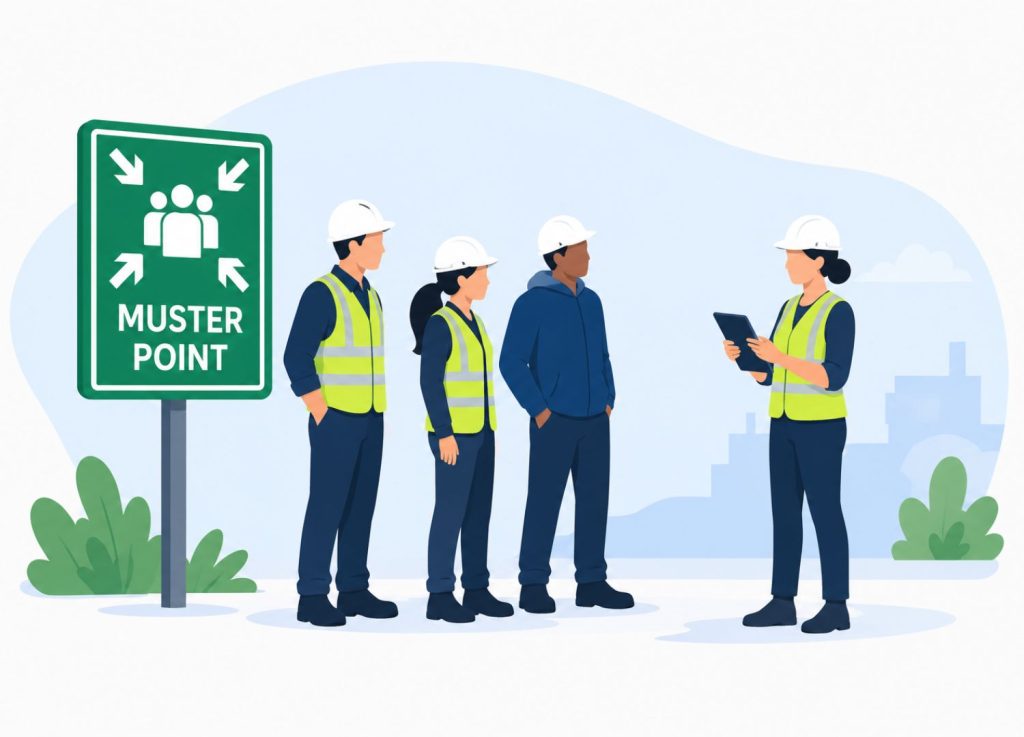
Table of Contents
A muster point is a designated, clearly marked location where workers gather for a headcount after evacuating a building or site during an emergency. It should be far enough from the hazard to keep people safe, upwind when possible, and easy for supervisors to reach. Most importantly, it gives everyone one known place to report so the site can quickly confirm who is accounted for and who is missing.
Key Takeaways
- A muster point gives evacuated workers a safe, designated place to report so supervisors can account for everyone.
- Muster point and assembly area are often used interchangeably. On larger sites, an assembly area may contain several muster points.
- Choose each point based on its distance from the hazard, wind direction, capacity, and accessibility.
- The headcount is the hard part. Badge-based mobile check-in can show who reached the muster point and who is still unaccounted for in seconds.
- OSHA 1910.38 requires emergency action plans to include procedures for accounting for employees after an evacuation. A well-planned muster point and reliable roll call help put that requirement into practice.
What a Muster Point Does
A muster point is a pre-planned location where a defined group reports after leaving a building or work zone during an emergency. Signage marks it, the emergency plan identifies it, and workers are trained to go there without waiting for instructions.
Its main job is accountability. Once workers reach the point, a supervisor compares the group against a known roster and identifies who is present and who is missing. That missing list gives incident commanders critical information about whether anyone may still be inside the building or work area.
The muster point only works if people can reach it safely and the headcount is accurate. A missed worker can send responders into a hazardous area unnecessarily, while an inaccurate count can leave someone unaccounted for when they actually need help.
Example: A distribution center evacuates after a smoke alarm at 2 a.m. with 84 workers on shift. The warden accounts for 82 and flags two as missing. Responders can focus their search on those two workers instead of treating the entire 400,000-square-foot facility as a question mark. If those workers badged out for a break minutes earlier, an accurate system can show that they are already off-site and prevent an unnecessary search.
Muster Point vs. Assembly Area
On most small sites, muster point and assembly area mean the same thing: a designated safe location where workers gather after an evacuation. The distinction becomes more useful as a site grows.
An assembly area is the broader safe zone away from the hazard, while a muster point is a specific location within that area where a crew or department checks in. A large plant might use the north parking lot as its assembly area, with maintenance at Point A, production at Point B, and office staff at Point C. One safe area, several muster points.
Shelter-in-place is different. Instead of sending people outside, it keeps them inside a designated, secured location when leaving the building could be more dangerous. This can apply to situations such as certain airborne chemical releases or an active threat.
| Response | Where people go | Primary purpose | Best when |
|---|---|---|---|
| Muster point | A specific marked spot outside | Group headcount and accountability | Fire, most evacuations, drills |
| Assembly area | A wider safe zone holding one or more muster points | Staging the whole evacuated population | Large or multi-building sites |
| Shelter-in-place | A sealed interior room | Keeping people away from an outdoor hazard | Some chemical releases, external threats |
How Many Muster Points You Need
There is no fixed ratio for how many muster points a site needs. The right number depends on the layout, hazards, workforce, and evacuation routes. Four factors should drive the decision:
Distance from the hazard: Place each point far enough away from fire, structural collapse, blast hazards, or other site-specific risks, and keep it clear of emergency vehicle routes. A warehouse fire and a pressurized gas leak may require very different setbacks. One central point can also create a problem if workers have to walk toward or past the hazard to reach it. If they do, add points so each crew has a safe route out.
Upwind position: Smoke and airborne releases can travel with the wind, turning a downwind muster point into another exposure. Where airborne hazards are a concern, designate points that account for changing wind conditions. A primary and secondary point on different sides of the site gives workers somewhere else to go if conditions change.
Capacity and accessibility: A muster point needs enough space for the largest realistic shift, not just the average headcount. Workers with mobility needs should have a clear, accessible route, while emergency vehicles need to reach the area without obstruction. A point behind a locked gate or across a flooded path is not a usable evacuation point.
Site size and layout: Large, distributed sites may need multiple muster points rather than one central location. In a Nyrstar deployment across Canadian mine sites spanning more than 25 kilometers, each zone needed its own reporting location, with counts rolling up into a single live view. As sites become larger and more spread out, the challenge becomes not just where people gather, but how quickly supervisors can combine those counts.
Even a small, single-building site should identify a primary and secondary muster point. If the primary is compromised by fire spread, wind, flooding, or a blocked route, workers should already know where to go instead.
Digital Roll Call at the Muster Point
The headcount, not the gathering, is where muster gets difficult. Getting workers to a safe location is straightforward. Proving within minutes that everyone arrived is what breaks down under pressure. Paper roll calls become outdated as soon as a contractor signs in or a worker leaves early, while reading names aloud in wind, noise, or a crowded assembly area takes time.
Digital roll call replaces the clipboard with a badge scan. Each worker’s existing RFID or NFC badge is scanned by a phone or tablet at the muster point, while present and missing lists update in real time.
Stratus-io runs on iPhone, iPad, Android, and Windows devices that wardens can already carry. It reads the badges workers already use, so there is no need to issue a separate evacuation credential. When a site has multiple muster points, counts can roll up into a single dashboard for the incident commander.
Badge-based accountability has one important limitation: it confirms who scanned in, not necessarily who is physically present. A worker who left their badge at a desk still needs a manual check. A short by-name exception check provides that fallback without requiring supervisors to repeat a full roll call.

Cloud-In-Hand® Solutions Team
This blog reflects the expertise of the Cloud-In-Hand® Solution Team with over 100 years of experience in hardware, software, and firmware development. Since founding Solutions Consulting in 1992, now known as Serialio LTD, the Solution Team has designed and developed many innovative solutions. Cloud-In-Hand® Stratus-io Time and Attendance, helps organizations like Apple, Google, Toshiba, LinkedIn, Salesforce, and many more, streamlining their operations.
Cloud-In-Hand® Solution Team
This blog reflects the expertise of the Cloud-In-Hand® Solution Team with over 100 years of experience in hardware, software, and firmware development. Since founding Solutions Consulting in 1992, now known as Serialio LTD, the Solution Team has designed and developed many innovative solutions. Cloud-In-Hand® Stratus-io Time and Attendance, helps organizations like Apple, Google, Toshiba, LinkedIn, Salesforce, and many more, streamlining their operations.
Frequently Asked Questions
What is a muster point?
A fixed, marked spot outside a building where people gather after an evacuation, so a supervisor can run a headcount and confirm no one is missing.
Muster point vs. assembly point?
Often used interchangeably. The distinction: a muster point is where a defined group checks in, while an assembly area is the broader zone that may contain several muster points.
How far should a muster point be from the building?
Far enough that a collapse, blast, or smoke plume can’t reach it, and clear of emergency vehicle routes.
Does OSHA require a muster point?
OSHA 1910.38 requires an emergency action plan accounting for all employees after an evacuation. It doesn’t use the phrase “muster point,” but a designated gathering location is the standard way to meet that requirement.
Can one muster point cover a whole site?
For a small site with just one building, yes, as long as you also have a backup point. Bigger sites or ones with multiple buildings need more than one muster point, each feeding into a combined headcount so you still get one final tally of who’s out.
Read More About Stratus-io

November 3, 2025
August 10, 2025